Master the swarm.
Twenty-four little robots. Put a brain hat on each, set down a light, and watch what they decide.
1–4 players · 14+Bots, brains, and pads.
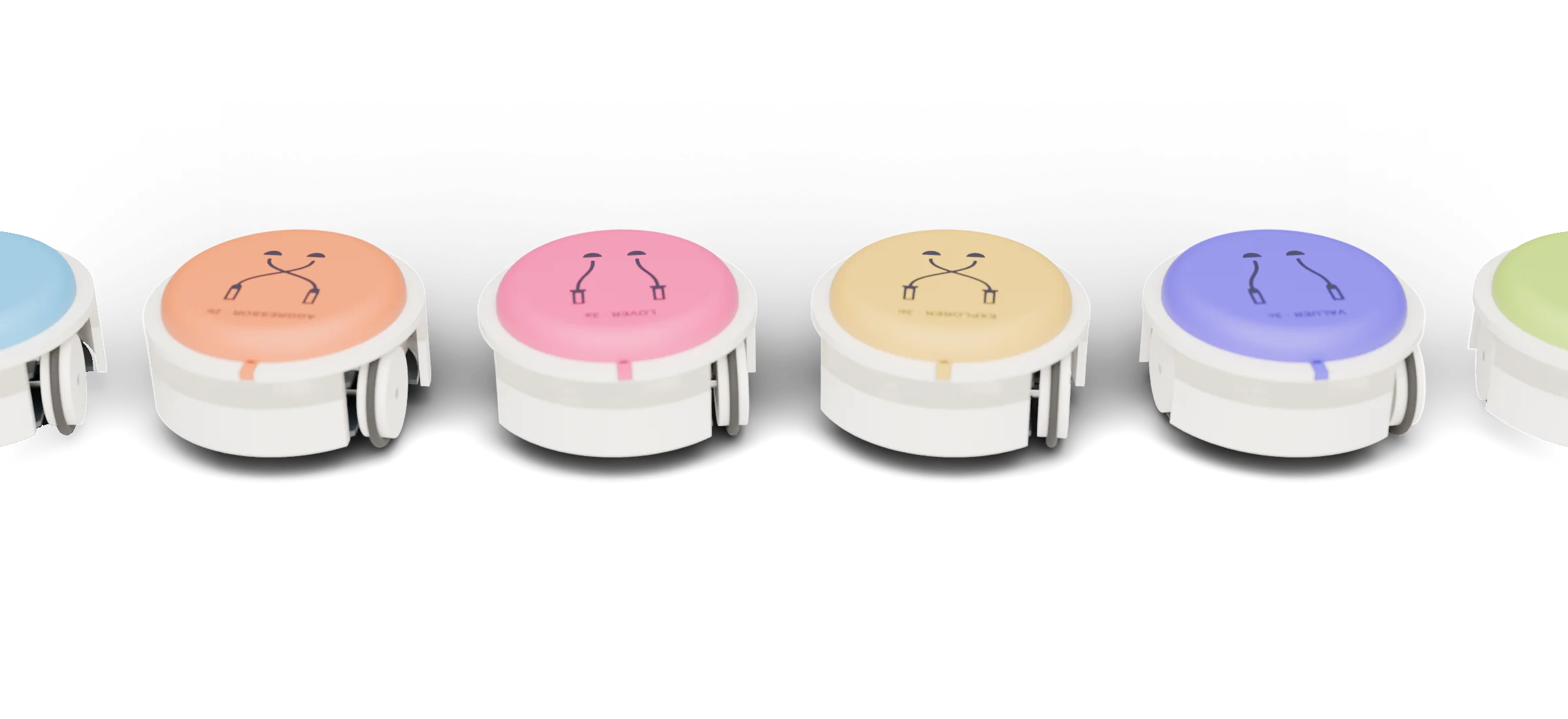
Every bot is the same. The hat you put on it decides how it reacts to what it sees.

How to play.
Set up in a few minutes, become the master of the swarm.
 Unroll the mat.Its black border keeps the bots on it.
 Put on the hats.Choose a brain hat for each bot.
 Place the pads.Set each one bright or dim, steady or pulsing.
 Watch.Then swap one hat and see what changes.
Pick your game.
Start with these three. The field guide has ten more, each a little harder to predict.

For developers and researchers.
Every part of Botmeister is open to change, from a single hat to the firmware.
A brain is 59 bytes: which signal drives which wheel, crossed or straight, faster or slower. Build one in the hat editor, watch a bot try it, then write it to a blank hat with your phone. The eight brains in the box use the same format.
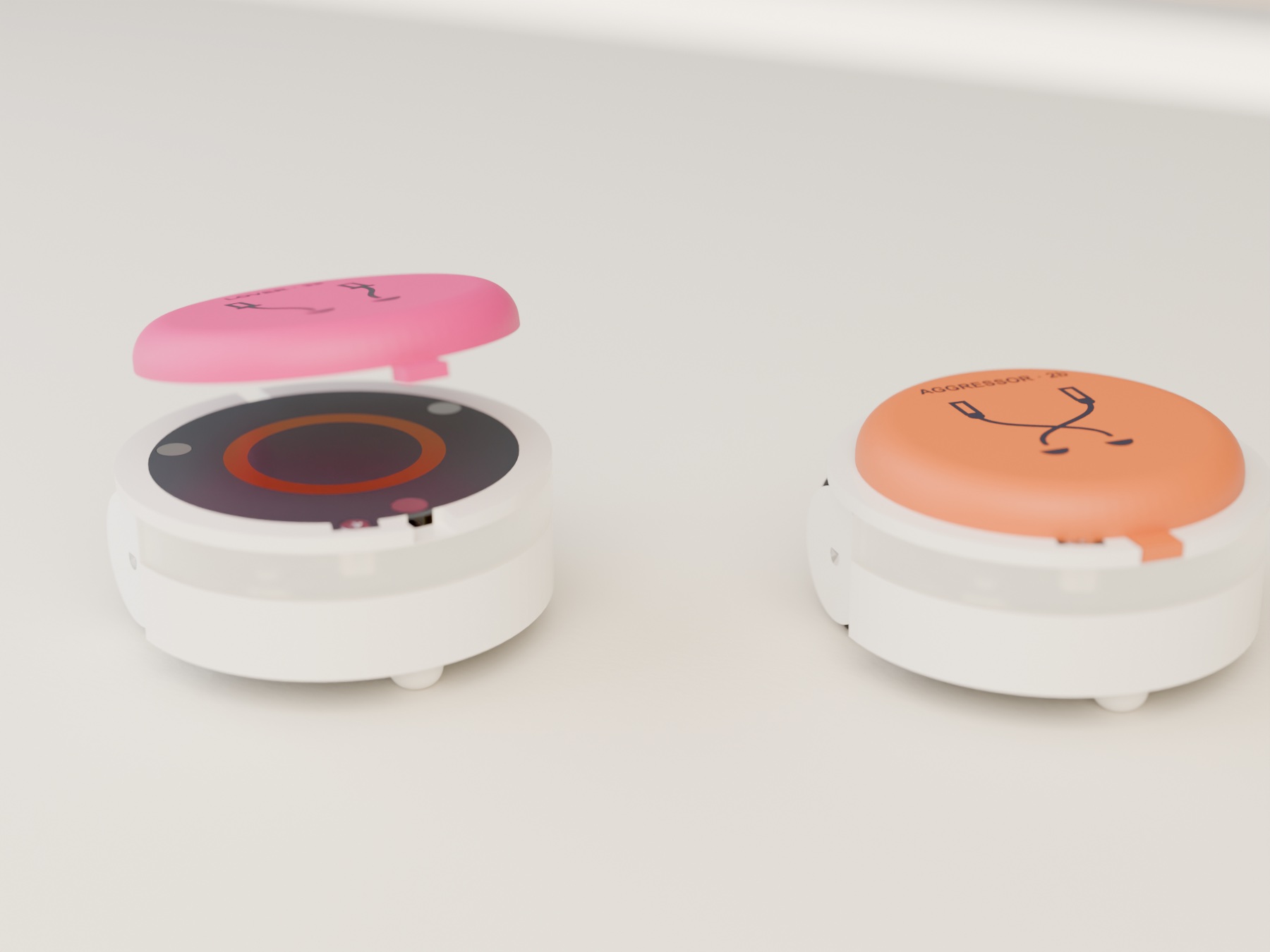
The firmware is plain C with host tests. Under each bot’s cover is a six-pad programming footprint: connect a Tag-Connect cable and a debug probe, and flash it with pyOCD.
The simulator runs the same brain format as the bots, and every run can be repeated from a fixed seed. Test an idea in the browser, then run it on the mat.
STEP files for every part, the netlist, the parts list and the checks the design passes, all in the workbench. Spare parts are standard: M1.4 screws, O-ring tyres, JST SH plugs.
Tinkerer’s guideMake a hatOpen the workbenchRun the simulator
What’s in the box.
Everything for one to four players. No app, no account, nothing to download.

- 24 VV-Bots, 40 mm across
- 48 brain hats, six of each kind
- 6 light pads, 90 mm across, 6.5 mm high
- 8 signal hats: two each of LIGHT, WARMTH, OXYGEN, FOOD
- 6 blind hats for Uphill Analysis
- 1 felt mat, 100 × 70 cm, with a black border
- 1 hard case that charges every bot and pad with the lid closed; the lid holds the hats
- 1 USB-C cable, 1 m, stored in the case (you need a USB-C charger, 45 W or more)
- 1 field guide with the rules for every game

The specs.
Plays in any normally lit room. The bots respond to infrared signals, not to room light.
- Bot
- Ø 40 × 22 mm
- Eyes
- Two infrared, ±30°
- Floor eye
- Sees the border and the pads
- Play
- Bots about an hour, pads about 20 minutes, a charge
- Charge
- About 1.5 hours in the case
- Battery
- 150 mAh, replaceable under a screwed cover
- Signals
- Seven infrared channels, 1.5–7.5 kHz
- Screens
- None. No app, no account, no Wi-Fi
- Hats
- NFC tags: write your own brain from a phone


The field guide.
Why does a Lover stop at the light while an Aggressor charges it? The answer is two wires.
The guide starts where Braitenberg started, with a vehicle simple enough to wire yourself. Then it covers every hat, every pad and all fourteen games, with the setup, how to win, and the line from the book behind each one.
Questions.
How many people can play?
One to four. Every game can be played alone, including Uphill Analysis: with blind hats, nobody knows the answers.
Do I need an app, an account or Wi-Fi?
No. Everything you need is in the box.
How long does a game take?
Most games take a few minutes. One charge lasts about 30 minutes of play, enough for three to five games. Charge and play between 0 and 35 °C: never in direct sun, on a heater or in a hot car. A bot that gets too hot slows down and rests until it has cooled.
How much space do I need?
Room for the mat, about 100 × 70 cm: a dining table or the floor.
Does room light confuse the bots?
No. Each pad and bot sends its own infrared signal, and the bots respond to those signals, not to room light.
Are the bots loud?
No. The motors make a quiet whirr.
Who is it for?
Anyone aged 14 and up who likes to predict, experiment and be surprised. There is no winner: the fun is in making patterns and learning to see them.